82.51×63: Understanding Its Meaning, Uses, and Importance

The term 82.51×63 may appear simple at first glance, but it carries significant relevance across multiple industries, including printing, design, manufacturing, and digital formatting. Measurements like this are commonly used to describe dimensions, aspect ratios, or sizing specifications for physical and digital products. Whether you are a designer, business owner, student, or simply curious, understanding what 82.51×63 represents can be surprisingly useful.
In this comprehensive guide, we will explore the meaning of 82.51×63, its possible applications, practical significance, and why such specific measurements matter in professional environments. By the end, you will have a clear understanding of how this size can be used and why precision in dimensions is essential.
What Does 82.51×63 Mean?
The format 82.51×63 typically represents a set of dimensions, most often in millimeters (mm), centimeters (cm), or pixels (px), depending on the context. It indicates a rectangular shape where:
-
82.51 refers to the width
-
63 refers to the height
In many real-world applications, this format is commonly used for:
-
ID cards
-
Business cards
-
Labels
-
Digital design layouts
-
Print templates
The exact unit of measurement depends on the industry using it, but millimeters are most common in printing and manufacturing.
Common Uses of 82.51×63 Dimensions
1. Card Printing Industry
One of the most common uses of 82.51×63 is in the card printing industry. Many identification cards, membership cards, and access cards use dimensions close to this size.
These cards are:
-
Easy to carry in wallets
-
Compatible with card readers
-
Durable and standardized
2. Business Cards
While standard business cards vary by region, some custom designs use sizes similar to 82.51×63 for a unique look. This slightly larger format allows:
-
More space for branding
-
Creative layouts
-
Better readability
3. Product Labels
Manufacturers often use this dimension for product labels. It provides enough space to include:
-
Product name
-
Ingredients
-
Barcode
-
Instructions
4. Digital Design Layouts
In graphic design, specific dimensions like 82.51×63 help maintain consistency across templates. Designers use it for:
-
UI components
-
Web graphics
-
Digital mockups
5. Printing Templates
Professional printers rely on precise dimensions to ensure accuracy. A small error in size can result in:
-
Misaligned text
-
Cropped images
-
Wasted material
Why Precise Measurements Matter
Precision is crucial in design and manufacturing. Even a difference of 1mm can affect:
-
Card fitting
-
Printing alignment
-
Product compatibility
For example, if an ID card is slightly larger than standard, it may not fit into card holders or machines.
check also: Steven Cauble: A Story of Determination, Growth, and Purpose
Benefits of Accurate Dimensions
-
Professional appearance
-
Cost efficiency
-
Compatibility
-
Consistency
82.51×63 in Millimeters vs Inches
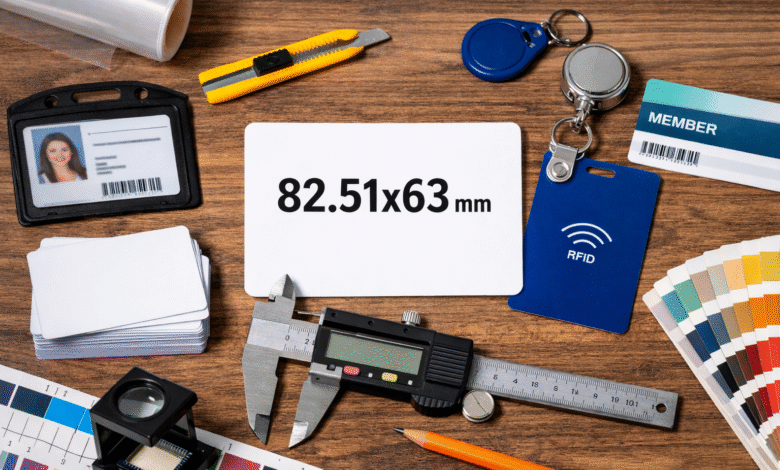
Many people prefer working with inches rather than millimeters. Here is a conversion:
-
82.51 mm = 3.25 inches
-
63 mm = 2.48 inches
This conversion is useful when:
-
Ordering from international suppliers
-
Using design software
-
Working with American printing standards
Aspect Ratio of 82.51×63
Aspect ratio is the proportional relationship between width and height.
For 82.51×63:
82.51 ÷ 63 ≈ 1.31
This means the aspect ratio is approximately 1.31:1
This ratio is ideal for:
-
Horizontal layouts
-
Cards
-
Labels
Designing for 82.51×63
When creating a design using these dimensions, consider the following:
1. Bleed Area
Always add a bleed margin (3mm) to prevent white edges after cutting.
2. Safe Zone
Keep important text away from edges.
3. Resolution
Use 300 DPI for print quality.
4. Color Mode
Use CMYK for printing.
Printing Tips for 82.51×63
To ensure professional results:
-
Use high-quality cardstock
-
Choose matte or glossy finish
-
Proofread before printing
-
Print test samples
Industries That Use 82.51×63
-
Banking
-
Education
-
Retail
-
Corporate offices
-
Healthcare
-
Events management
These industries use this size for:
-
ID cards
-
Membership cards
-
Gift cards
-
Event passes
Customization Options
This size allows for creative customization:
-
Rounded corners
-
Embossing
-
Foil stamping
-
QR codes
-
Holograms
Customization enhances:
-
Security
-
Brand image
-
Visual appeal
Digital Applications
Beyond physical printing, 82.51×63 is also used digitally:
-
App interfaces
-
Social media templates
-
Online banners
-
UI buttons
Designers scale this size for responsive layouts.
Advantages of Using 82.51×63
-
Compact and portable
-
Professional appearance
-
Flexible design space
-
Cost-effective production
-
Industry acceptance
Challenges and Limitations
While useful, this size has some limitations:
-
Limited space for long text
-
Not ideal for vertical layouts
-
Requires precision in printing
However, creative design can overcome these challenges.
Comparison With Other Sizes
| Size | Usage |
|---|---|
| 85.6×54 mm | Credit cards |
| 90×50 mm | Business cards |
| 82.51×63 mm | Custom cards & labels |
This shows how 82.51×63 fits between common standards.
Environmental Considerations
Sustainable printing options:
-
Recycled paper
-
Soy-based inks
-
Digital proofs instead of paper
These practices reduce environmental impact.
Future of Standardized Dimensions
As technology evolves:
-
Digital cards may replace physical ones
-
QR-based ID systems
-
NFC-enabled cards
However, physical cards remain relevant for security and accessibility.
Creative Ideas Using 82.51×63
-
Loyalty cards
-
Appointment cards
-
Mini photo prints
-
Event invitations
-
Discount vouchers
FAQs
1. What does 82.51×63 represent?
It represents a set of dimensions, usually in millimeters, used for cards, labels, and designs.
2. Is 82.51×63 a standard size?
It is a semi-custom size used in specific industries.
3. What is 82.51×63 in inches?
Approximately 3.25 x 2.48 inches.
4. Can I use this size for business cards?
Yes, it works well for custom business card designs.
5. What resolution should I use for printing?
Use 300 DPI for high-quality print results.
6. Is 82.51×63 good for ID cards?
Yes, it is commonly used for ID and membership cards.
7. What material works best?
PVC, cardstock, or laminated paper.
8. Can I use it for digital design?
Yes, it is great for UI and graphic templates.
9. Does this size fit in wallets?
Yes, it fits comfortably in most wallets.
10. Should I add bleed to my design?
Yes, always add a bleed margin for printing.
11. Can I customize this size?
Absolutely, with finishes like embossing and foil.
12. Is it suitable for labels?
Yes, it works well for product and packaging labels.
Conclusion
The dimension 82.51×63 may look technical, but it plays a vital role in design, printing, and manufacturing industries. From ID cards and business cards to digital layouts and product labels, this size offers versatility, portability, and professional appeal.
Understanding how to use it correctly ensures better design outcomes, cost efficiency, and user satisfaction. Whether you are a designer, business owner, or student, mastering such dimensions empowers you to create impactful and practical designs.
As technology advances, standardized sizes like 82.51×63 will continue to remain relevant due to their convenience and compatibility. With the right approach and creativity, this dimension can be used to produce visually appealing and functional designs that leave a lasting impression.
If you are planning your next design or print project, consider using 82.51×63 for a professional and versatile result.
You May Also Visit
Ruth Jones Net Worth: A Deep Look at Her Career, Income Streams, and Lasting Success